top of page

SEWAGE TREATMENT PLANT (STP)

  • Writer: Ragul D Krishnaraj
    Ragul D Krishnaraj
  • Feb 5, 2019
  • 2 min read

WHAT IS SEWAGE?


•Sewage comprises waste water generated from households, hotels and may include industrial waste water.


WHAT IS THE SEWAGE TREATMENT PLANT


•It’s newly developed technology which purifies domestic wastewater for reuse.


•When water from your sink and kitchen flows through drainage to the sewage tank (mostly situated outskirt of the city), the water treatment plants filter the water by breaking down all contaminants including organic waste into it.


WHAT TYPE OF WASTE DOES SEWAGE CONTAIN?


•Sewage usually contains a high quantity of organic wastes and may also consist of inorganic wastes. It is essential to treat sewage before its entry into any water body. Why so?


• Sewage, if allowed to enter water sources without treatment, it will contaminate them; which is why it is essential to treat sewage properly before letting it into rivers or streams


SEWAGE TREATMENT PLANT PROCESS
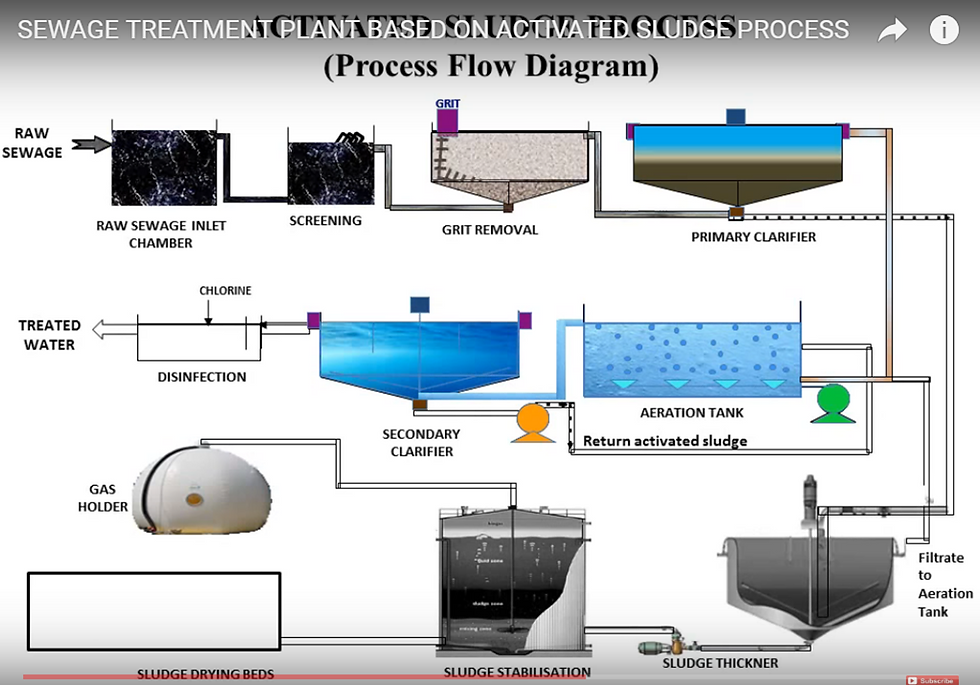


STP PROCESS

PRIMARY TREATMENT


•In this process, the effluent or the sewage flows through huge tanks called the primary sedimentation tanks.


• In these tanks, the sludge settles down while grease and oil float on the surface and are removed.


•These tanks have scrapers that continuously push the sludge that is collected, towards the hopper in the base of the tank


•It is then pumped for the sludge treatment.


SECONDARY TREATMENT


•In this process, the biological waste from the human waste, soap, food waste, and detergent are substantially degraded.

•Most of the municipal sewage water treatment plants treat the sewage that is settled through the aerobic process.


• The effluent after the primary treatment has dissolved biological matter.


• This is then converted into clean water by making use of the bacterial and waterborne aerobic micro-organisms that absorb the pollutants.


•The effluents from this process are clean enough to be discharged into the rivers.


TERTIARY TREATMENT


•Tertiary treatment is the final cleaning process that improves wastewater quality before it is reused, recycled or discharged to the environment.


•The treatment removes remaining inorganic compounds, and substances, such as the nitrogen and phosphorus.


•Bacteria, viruses and parasites, which are harmful to public health, are also removed at this stage.


SLUDGE TREATMENT


•The sludge that is accumulated in the treatment is further treated and disposed of in a safe manner.

•The sludge is passed through thickeners that dewater it.

• This sludge is then transported for disposal in a landfill or used for agriculture soil amendment.


Advantages of Sewage Treatment Plant


•STP is proven technology which offers reliable performance at all time


•Sewage treatment plant preserve natural environment against pollution


•STP meet the standards for emission of pollutants set by the Government & avoid heavy penalty


•Simple and easy installation, low operation and maintenance of plant


•Installation of sewage treatment plant reduces risk to public health and the environment


Why reuse or recycle Water?

•Though 70% of earth is surrounded by water only 2.5% of it is fresh water.

•Out of which 70% fresh water is in frozen state on Antarctica and Greenland.

•Only nearly 1% of fresh water is accessible for usage. In day to day life we use water majorly for washing, bathing, toilet etc.

•if we can recycle water for other than drinking purpose fresh water demand can be lowered.


•Hence it is very important to treat sewage outlet of every building and reuse treated water for washing, toilet and floor cleaning.


Comments


© 2019 by Ragul D Krishnaraj. Developer

  • Grey Twitter Icon
Never Miss a Post. Subscribe Now!

I'm a paragraph. Click here to add your own text and edit me. It's easy.

bottom of page